
Join other MTSA alumni in mission and service efforts both locally and across the globe!

As a Christian institution, MTSA emphasizes the importance of giving back to others and integrating compassion into professional practice. Students and faculty are encouraged to actively serve their communities, reflecting MTSA’s commitment to caring for others both inside and outside the clinical setting.
Through structured programs and volunteer opportunities, service becomes an extension of the classroom—allowing students to apply their skills, develop leadership, and cultivate a lifelong commitment to helping others.
There are no mission and service opportunities at this time. Check back to find out where you can lend your expertise or helping hands.
Dr. Spiegel has been a Certified Registered Nurse Anesthetist since 1987 and a licensed attorney in the state of Florida since 2005. In 2022, Dr. Spiegel retired from her position as Assistant Professor and Program Director of the Florida Gulf Coast University Nurse Anesthesiology Program in Fort Myers, Florida and currently engages in clinical practice at an outpatient surgery center in Lecanto, Florida. Dr. Spiegel earned a Diploma in Nurse Anesthesia from the Mary Hitchcock Memorial Hospital School of Nurse Anesthesia at the Dartmouth-Hitchcock Medical Center in 1986, a Juris Doctor degree, magna cum laude, from the Florida International University College of Law in 2004, and a Doctor of Nurse Anesthesia Practice degree from Virginia Commonwealth University in 2013. From 2005 to 2006, Dr. Spiegel served as an Assistant Public Defender for the Law Offices of the Public Defender for the Eleventh Judicial Circuit of Florida, and from 2006 to 2011, she was in private practice as a trial lawyer primarily representing claimants in disability insurance disputes in state and federal courts. She has been an invited speaker on various legal, ethical, and clinical topics at local, state, and national professional meetings.
Dr. Overstreet earned her PhD in Nursing at the University of Tennessee, Knoxville in 2009. Her selected studies focused on nursing education methodologies including adult education and the use of nursing clinical simulation and debriefing exercises. Dr. Overstreet’s research focused on the current practice of nursing clinical simulation debriefing. Overstreet’s research findings led to the identification of three new patterns among educators and Fellows alike: accentuate the positive, higher order thinking, and experience counts.
Those patterns have driven Dr. Overstreet to focus on creating successful mentoring partnerships between the Fellows and faculty at MTSA. Serving as a mentor to nursing and nurse anesthesia Fellows at both the masters and doctoral levels, as well as faculty, Dr. Overstreet strives to look at the whole person when evaluating and advising on successes and areas for improvement. Consideration of the mentee’s physical, emotional, spiritual, and social health are just as important as their academic status, and Dr. Overstreet encourages mentors to incorporate strategies to ensure the mentee walks away with attainable goals and expectations, as well as resources they may need for support along their educational journey.
In 2017, Dr. Overstreet joined the Georgia Independent Colleges Association’s Higher Education Leadership Development (HELD) Mentor Program, where she provides one-on-one mentorship in development of leadership and skills in higher education for new Deans of a university in that state.
While away from campus, Dr. Overstreet enjoys growing summer fruits and vegetables and watching the daily antics of her foster cats and squirrel.
Dr. Jordan is a CRNA who serves as the AANA Foundation’s CEO and AANA Chief Advocacy Officer. Lorraine works for the American Association of Nurse Anesthesiology and earned her anesthesia and doctoral degrees from The Ohio State University in Columbus, Ohio. In her role of Chief Advocacy Officer, she oversees Federal Government Affairs, AANA PAC, State Government Affairs, Practice, Wellness, Professional Education, Publications, Fellows Program and Research and Quality Departments. She serves as the CEO of the AANA Foundation, a nonprofit organization that supports research and education of nurse anesthetists. Dr. Jordan has been active and served in several organizations such as a surveyor for the Accreditation Association for Ambulatory Health Care, Chair of the Interagency Collaborative on Nursing Statistics, Academy Health, American Academy of Nursing, and Chair of the Nursing Foundation’s organization. Dr. Jordan’s passion includes nurse anesthesia education, quality and outcomes, the impact of anesthesia care, cost-effectiveness and healthcare policy.
Wendy Hoersting has been a clinical preceptor and student mentor since entering the anesthesia arena in 1997. For 25 years, her focus has been on her family, anesthesia practice, and community. Wendy currently serves as the sole CRNA to an oral surgery practice in coastal Georgia and offers shadowing and college planning to high school and college students. Due to a love for learning and the nurse educator track’s introduction, she returned to complete her DNAP at Middle Tennessee School of Anesthesia. Some areas of interest include evidence-based practice, provider self-care, advocacy, and mentoring.
Derek Bruff is an educator, author, and higher education consultant. He directed the Vanderbilt University Center for Teaching for more than a decade, where he helped faculty and other instructors develop foundational teaching skills and explore new ideas in teaching. Bruff consults regularly with faculty and administrators across higher education on issues of teaching, learning, and faculty development. Bruff has written two books, Intentional Tech: Principles to Guide the Use of Educational Technology in College Teaching (West Virginia University Press, 2019) and Teaching with Classroom Response Systems: Creating Active Learning Environments (Jossey-Bass, 2009). He writes a weekly newsletter called Intentional Teaching and produces the Intentional Teaching podcast. Bruff has a PhD in mathematics and has taught math courses at Vanderbilt and Harvard University.
Dr. Christi Williams is a physical therapist and an Associate Professor in the School of Physical Therapy at Belmont University in Nashville, TN. Dr. Williams is an APTA Board Certified Clinical Specialist in Orthopedics and has also received her certification from the McKenzie Institute as a specialist in Mechanical Diagnosis and Therapy of the Spine. She serves as the director of anatomy at Belmont and teaches Human Anatomy in the physical therapy program, which includes full cadaveric dissections. In addition, she teaches Clinical Pathophysiology II and Kinesiology labs which help link the students’ basic understanding of anatomy & physiology to understanding the disease process and developing basic clinical examination skills for neuromuscular assessment.
Ken Wetmore, MA, serves as the Senior Pastor of WholeLife Church in Orlando, FL, in addition to teaching in the Fellowship. He received his Master of Arts in Organization Leadership from Gonzaga University and his Bachelor of Arts in Communications from Southern Adventist University. Ken Wetmore joined the MTSA faculty as School Chaplain in 2012 and served in that position until 2021, which included teaching the Religion courses in the entry to practice program. He also served as the senior pastor at the historic, Madison Campus Seventh-day Adventist Church from 2016 to 2021. Although Pastor Wetmore no longer acts as MTSA School Chaplain, he continues to be an integral part of the Acute Surgical Pain Management Fellowship. Prior to becoming a pastor Ken worked in public relations and broadcast news. He has traveled extensively and has lived in New Zealand and Guam. His hobbies include reading, rugby, softball, music, and photography.
Scott M. Urigel, MSN, CRNA, earned his MSN at the Cleveland Clinic School of Nurse Anesthesia, Case Western Reserve University. He is a co-owner of Western Reserve Anesthesia Education and developer of the Block Buddy App, which is designed to assist in performing ultrasound-guided nerve blocks and point of care ultrasound (POCUS). Scott is a practicing CRNA at the Institute of Orthopedic Surgery where he performs general and ultrasound-guided regional anesthesia. He is also affiliated with Maverick Medical Education, where he contributes as an instructor in advanced pain management and POCUS.
Rhea Temmermand, PhDc, MSN, CRNA, FAANA is a distinguished research scientist specializing in neuropharmacology within the Department of Pharmacology and Physiology at Drexel University. Her research focuses on the role of glutamate transporters in astrocytes and their impact on pain modulation, with particular emphasis on neuropathic pain, non-opioid drug development, and opioid addiction. In addition to her full-time research endeavors, she serves as an Adjunct Professor in Drexel University’s Nurse Anesthesia program and is the co-editor of a comprehensive science textbook designed for nurse anesthesiologists. She is also the co-founder of Atomic Anesthesia, an innovative EdTech company dedicated to transforming complex scientific and clinical concepts into accessible and practical resources for nurse anesthesia residents and CRNA faculty.
Dru is a Professor and Director of Clinical Education at Texas Christian University and co-chair of the Cochrane US Network. He practices clinically in Fort Worth TX and has an interest in pharmacogenomics having completed his PhD at the Medical University of South Carolina. Dru is an active clinician, academic, and researcher.
Steve Parish, MHS, CRNA, is currently the full-time Vice-Chief Nurse Anesthetist at John Peter Smith Hospital, a level-one trauma center in Fort Worth where he also serves as a CRNA. Mr. Parrish has been performing regional anesthesia for 8 years and is active in educating his hospital and anesthesia group in r/t regional anesthesia. He assisted with the establishment of the Acute Pain team for John Peter Smith Hospital in 2016. His goal is to help facilitate the education of regional anesthesia to those desiring to broaden their professional practice.
Daniel Nash, DNAP, CRNA, earned his Doctorate of Nurse Anesthesia Practice from Texas Wesleyan University and has been providing anesthesia as a sole practitioner and care team member since 1994. Dr. Nash is currently a partner at Maverick Regional Anesthesia Educators, LLC which provides schools, anesthesia groups, and working CRNAs with regional anesthesia education and Acute Pain Service consultation. He assisted with the formulation and implementation of the block program at a large hospital system in Texas and his specialty areas include pediatrics and regional blocks. He and his wife, Cathy, have been married for 35 years and have two children and two grandchildren. Dr. Nash loves fishing and music.
Patrick Moss, DNAP, CRNA, received his Master of Science with a focus in nurse anesthesia and Doctorate of Nurse Anesthesia Practice from the Middle Tennessee School of Anesthesia. His passion for educating colleagues about acute pain management – particularly those practicing in rural or underserved areas – led to doctoral work focused on determining the feasibility of tele-mentoring (remotely guiding) other CRNAs who have limited, or no, experience in providing ultrasound-guided regional anesthesia. He has practiced nurse anesthesia for the last 19 years and is the Regional Vice President of Anesthesia Services for LifeLinc Anesthesia. He also serves as the Director of the Center of Excellence for Acute Pain Management for the Middle Tennessee School of Anesthesia and Halyard Health, facilitating quarterly cadaveric workshops focused on ultrasound-guided regional anesthesia. He and his wife, Mandy, have been married for 20 years and have two children, Parker and Will.
Jeffrey Molter, MSN, MBA, CRNA, earned his MBA from Lake Erie College and his MSN at Case Western Reserve University. He is a practicing CRNA, owner, and president of Western Reserve Anesthesia Associates, an outpatient anesthesia center. He is a co-owner of the Block Buddy App for iPhone and Google, instructor and guest lecturer for Frances Payne Bolton School of Nursing at Case Western Reserve University, and guest lecturer for anesthesia programs throughout Ohio Lourdes University, Akron University, and Otterbein University.
Munir Merchant, MD, is an anesthesiologist with diverse experience. He is licensed in Texas, Missouri, and Arkansas, and currently is practicing in Fort Worth, TX. He received his medical school training at the Seth GS Medical School in Mumbai, India. He completed residencies and internships in India and New York. He completed his fellowship in the Department of Pain Medicine at St. Luke’s Roosevelt Hospital Center, NY. Dr. Merchant has worked in a defense force hospital in Bahrain and then moved to the United States. He is committed to the field of anesthesia and pain management.
Kelly Martin, MS, CRNA, received his Master of Science with a focus in nurse anesthesia from the WellSpan Health/York College of Pennsylvania nurse anesthesia program. He has been performing ultrasound-guided regional anesthesia for the past 6 years and currently serves as a member of the acute pain service at York Hospital. Kelly is also full-time faculty for the anesthesia program at York College of Pennsylvania. He is passionate about teaching acute pain management in both the classroom and clinical settings. Upon completion of the acute surgical pain management fellowship, Kelly’s goal is to help the acute pain service at York Hospital continue growing and to operate based on current guidelines and recommendations to provide safe and effective care.
Serge Marchand, PhD, is a professor at the Faculty of Medicine and Health Sciences at Université de Sherbrooke. A neuroscientist by training, Dr. Marchand specializes in the neurophysiological mechanisms underlying chronic pain. His expertise includes pain evaluation in chronic pain patients, human somatosensory psychophysics, human electrophysiology, and endogenous pain modulation.
Dr. Marchand has held several key leadership roles in research and health sciences. He served as Scientific Director of the Sherbrooke University Hospital Research Center (2008-2013), Vice-President of Scientific Affairs at Genome Québec (2019-2020), and Scientific Director of the Fonds de recherche du Québec—Santé (2017-2019). During his tenure, he played a pivotal role in shaping research strategies and fostering scientific collaboration. From 2002 to 2010, he also held the Joint Chair in Physiopathology of Pain at UQAT-Université de Sherbrooke.
A prolific author, Dr. Marchand has written extensively on pain neurophysiology, publishing numerous scientific articles, book chapters, and books. His works include The Pain Phenomenon (Springer, 2024) and Mental Health and Pain (Springer Press, 2014).
Beyond his research, Dr. Marchand has contributed to national and international evaluation committees, providing expert insights to advance the field of pain science. His work continues to influence research, clinical practice, and healthcare policy.
Mike MacKinnon graduated with a Master of Science in Nursing degree from Thomas Jefferson University in 2009, UMASS Boston as a Family Nurse Practitioner in 2015, and earned a Doctor of Nurse Practice degree from the University of Alabama in 2018. He has a special interest in difficult airways, ultrasound regional anesthesia, the business of anesthesia, and chronic pain management. Mike is co-owner of CE2 (www.ce2you.com) which trains CRNAs in the use of Ultrasound and non-surgical pain management.
Mike is currently the VP of Clinical and Practice Management for Valley Regional Anesthesia Associates (VRAA).
Brian Kasson, DNP, CRNA, is an associate clinical professor at the Northern Kentucky University Nurse Anesthesia Program. He was a faculty member and speaker at the AANA’s highly acclaimed Spinal and Epidural Workshops for over 10 years and was the president of the Ohio State Association of Nurse Anesthetists. As author and coauthor, he has published in the AANA Journal, Anesthesia and Analgesia, as well as the chapters on Obstetrical Anesthesia in the 5th and 6th editions of Nagelhout’s textbook Nurse Anesthesia. As a speaker, he has presented at the state and national level.
Dr. Halle, PT, PhD, ECS (Emeritus), earned his doctoral degree from the University of Iowa with a focus on Exercise Science. Dr. Halle was with the Belmont Physical Therapy Program from1997 through May 2021, serving as Chair of the program from 2005 through May 2013. While Dr. Halle retired in 2021, he remains engaged with select classes within the Belmont Physical Therapy Program as an Emeritus Professor, and he continues to have an adjunct appointment within the Department of Medical Education and Administration at the Vanderbilt University School of Medicine. His professional areas of interest include anatomy, electrophysiological evaluation, orthopedics and sports medicine.
Ms. Goodwin began her career in Nursing in Cardiology and Post Angioplasty and proceeded on to manage the Cardiac/EP Practice at Sutherland Cardiology for Dr Galen Van Wyhe for 10 years. She worked for Avanos Medical for 10 years in the Acute Pain Division, Clinical Educator in the OR and patient care units, and presenting the benefits of an Acute Pain practice to administration and training nurses to assist in continuous peripheral nerve block and non-narcotic pain management
After receiving her Masters Degree in Healthcare Administration and Education she assisted in building the education department to further the mission on non and reduced narcotic pain management. She is passionate about narcotic reduction while building confidence in the medical process.
David has over 25 years of experience providing professional anesthesia services across all patient populations. He earned a BS in Nursing from Texas Christian University in 1993, a Masters in Health Sciences from Texas Wesleyan in 1998, and completed the Advanced Pain Management Non-Surgical Pain Management Fellowship through Texas Christian University in 2017-18. He was one of the first 50 Certified Registered Nurse Anesthetists in America to become board-certified in Non-Surgical Pain Management (NSPM-C). He relied on his extensive clinical experiences providing acute pain management techniques to form Maverick Medical Education with his good friend and coworker Dan Nash in January 2010. After completion of his pain fellowship, he opened Republic Pain Specialists in March 2019. Republic Pain Specialists was the first office-based pain practice owned by a CRNA in the state of Texas.
Jamie Furstein, PhD, DNAP, CRNA, CPNP-AC, FAANA, received his Master of Science in Nursing with a concentration in Nurse Anesthesia from the University of Cincinnati in 2004. He worked at Cincinnati Children’s Hospital Medical Center for over 20 years before transitioning to an adult practice. Soon after Jamie embarked on his career as a CRNA, he refined his academic interests to explore techniques to manage pain in the pediatric population better. His efforts to ameliorate pain among pediatric patients have mainly focused on using ultrasound-guided regional anesthesia (UGRA) in clinical practice. As his clinical understanding expanded, so did his scholarly inquiry. Jamie remains actively involved in research on pediatric pain and is currently the Primary Investigator for several ongoing clinical trials. Over the years, Jamie has remained steadfast in his commitment to sharing the knowledge gained with future generations of clinicians. He has continually lectured at both local and national meetings and has repeatedly served as a hands-on instructor at the national level. Currently, he is faculty at three graduate nurse anesthesia programs and has developed several hands-on UGRA workshops designed for practicing clinicians wishing to incorporate UGRA into their clinical practice. The expertise he has gained throughout his career, in addition to his service to the nurse anesthesia community, has led to him receiving multiple awards for his contributions. Today, Jamie serves on several editorial boards guiding the literature specific to UGRA and pain management and continually seeks opportunities to further nurse anesthesia practice.
Helen Fosam, PhD, has 18 years of writing experience within academia and medical education. She currently serves as an international consultant, developing content for physician education in neurology, covering acute and chronic pain management, and has written numerous articles targeted at the physician audience focused on a pharmacological and non-pharmacological approach to pain management. She earned her PhD and completed her Post Doctorate research (Physiology) at Sheffield University, UK.
Masson D. Farmer, DNP, CRNA is a Certified Registered Nurse Anesthetist practicing independently in Texas. He earned his Master of Science in Nurse Anesthesia and Doctor of Nursing Practice Anesthesia from Texas Christian University. His doctoral work focused on aspects of multimodal analgesia sparking an interest in the field of acute pain management. He enjoys incorporating new ultrasound guided regional techniques into his practice and serving as a resource to his clinical colleagues. He advocates for the unencumbered practice of Nurse Anesthetists in Texas through volunteering for TxANA and the AANA and serves as a resource for regulatory and practice matters impacting Texas CRNAs. Outside of anesthesia, his interests include building/tinkering, cooking, drumming, and listening to music. He and his wife Carrie have one son.
John M. Edwards III, DNAP, CRNA, earned his Bachelor of Science degree from Murray State University in 1996 and his Master of Science in Anesthesia from Middle Tennessee School of Anesthesia in 2002. In January 2019, he completed the Acute Surgical Pain Management Fellowship from Middle Tennessee School of Anesthesia. In August 2021, he completed the Doctor of Nurse Anesthesia Practice degree at Middle Tennessee School of Anesthesia. John has been practicing at Baptist Health Lexington in Lexington, KY since 2004, where he Co-Founded and Co-Directs an Acute Pain Service. He is also the Co-Founder of Thoroughbred Anesthesia Academy and is a Course Collaborator at Middle Tennessee School of Anesthesia in the Acute Surgical Pain Management Fellowship. John is a member of several medical professional committees such as the Baptist Health Lexington Acute Pain Committee, Baptist Health Lexington Opioid Committee, and the Baptist Opioid Safety and Ensurement (BOSE) committee. As Chair of the Acute Pain Committee, John has led the development of Baptist Health’s Acute Surgical Pain Management Guidelines and Acute Pain Order Set to provide a comprehensive approach to acute surgical pain management.
Stace D. Dollar, DNAP, CRNA, has been a practicing Certified Registered Nurse Anesthetist for 20 years and currently serves at Baptist Health Lexington, in Lexington, KY. He received his Doctorate of Nurse Anesthesia Practice from Middle Tennessee School of Anesthesia. He co-founded and co-directs an Acute Pain Service that has developed Enhanced Recovery After Surgery (ERAS) and regional anesthesia protocols for orthopedic joint replacement, neurosurgery, general surgery, breast cancer, urology, bariatrics, and plastics surgeries that improve patient outcomes and decrease length of stay. Dr. Dollar has traveled to Haiti with MTSA and the Touching Hands Project to serve on mission trips. While in Haiti, he was able to teach various regional anesthesia techniques to MTSA students. Dr. Dollar is also a clinical facilitator at the quarterly advanced cadaveric workshops facilitated by the Middle Tennessee School of Anesthesia.
Jason Crosslin, MS, CRNA, received his Master of Science with a focus in nurse anesthesia from Middle Tennessee School of Anesthesia and currently serves as a CRNA at LifeLinc Anesthesia. He also serves as a Regional Clinical Coordinator for Middle Tennessee School of Anesthesia at Northcrest Medical Center. He has been a member of both the Admissions Council and Progressions Committee at MTSA.
Desiree Chappell, CRNA, is based in Louisville, KY. She has coordinated and assisted with the implementation of successful Enhanced Recovery Programs. She also serves as Associate Editor, US Lead, Anchor, TopMedTalk; Board of Directors for the American Society of Enhanced Recovery; Scientific Advisory Panel for Evidenced Based Perioperative Medicine (EBPOM)-USA; Founding Co-Director of PoCCo, LLC, The Perioperative Coaching Company.
Michael Burns has been a CRNA for 21 years and an active member of AANA, MOANA, ASRA, and ESRA professional organizations. His clinical practice and research areas of interest are ERAS, acute pain management, and regional anesthesia. Burns’s lifelong focus has been to improve his patient’s safety, experience, and access to affordable healthcare in an economical responsible manner by educating future and present nurse anesthetists. Burns is a consultant and advisory panel member for several anesthesia medical device companies such as B Braun, Avanos, Teleflex, Edward’s Lifescience and Cumberland Pharmaceutics assisting with their development of new products and advancing the utilization of their current products as well as a medical legal consultant.
Patrick S. Myer, DNAP, CRNA, has been a practicing Certified Registered Nurse Anesthetist since March 2006. He received his Master’s of Science in Nurse Anesthesia from Georgetown University and his DNAP from MTSA. He is also a graduate fellow of the inaugural cohort of the MTSA Acute Surgical Pain Management Fellowship. Patrick has a passion for patient-centered care and teaching others. He is an expert in regional anesthesia and point of care ultrasonography and frequently provides lectures and didactic instruction to other health professionals for regional anesthesia and point-of-care ultrasound examinations. Patrick currently works at SSM Health Bone and Joint Hospital in Oklahoma City, OK, as the Chief CRNA. He also serves as the clinical site coordinator for Middle Tennessee School of Anesthesia’s Acute Surgical Pain Management Fellowship.
Lower Extremity Peripheral Nerve Blocks I (PENG)
Assistant Director, Acute Surgical Pain Management Fellowship
Nicolette B. Hooge, DNP, MBA, CRNA, is the Assistant Director of the Middle Tennessee School of Anesthesia’s Acute Surgical Pain Management Fellowship. In this role, she coordinates the clinical practicum, facilitates the fellowship seminar series, and organizes cadaveric and Point-of-Care Ultrasound (PoCUS) workshops. With 15 years of experience as a CRNA, Nicolette is actively engaged in clinical practice at VSON Alpine Orthopedic Surgery Center. She earned her Doctorate of Nursing Practice (DNP) from the Johns Hopkins School of Nursing and a Master of Business Administration (MBA) from Johns Hopkins Carey Business School. Nicolette has published in peer-reviewed journals and serves on the AANA finance committee as well as other professional national and regional committees.
Email: nicolette.hooge@mtsa.edu
Phone: 615-732-7667
Christian Falyar is the Director of the Acute Surgical Pain Management Fellowship at the Middle Tennessee School of Anesthesia. As a former board-certified vascular sonographer, he has been involved in ultrasound-based education for nearly twenty years dating back to his research with transcranial Doppler sonography in patients suffering from subarachnoid hemorrhage. In addition to his role as Fellowship director, Dr. Falyar coordinates the cadaveric workshops, and teaches the regional anesthesia point-of-care ultrasound curriculum for the entry to practice program. Additionally, he holds an adjunct faculty position in the Department of Nurse Anesthesia at the University of Iowa. He lectures locally, regionally, and nationally on ultrasound related topics, and has been published in numerous peer-reviewed journals. For the past ten years, Dr. Falyar has served as the coordinator for the open ultrasound scanning labs at the AANA Annual Congress.
Email: christian.falyar@mtsa.edu
Phone: 615-732-7663
Dr. Bradley Steg earned his Bachelor of Science from Middle Tennessee State University and his Doctorate of Nursing Practice from Union University, graduating as the class valedictorian for both degrees. In addition to earning his diploma, Dr. Steg received both the clinical and academic excellence awards as a SRNA.
Dr. Steg began his CRNA career at Jackson Madison County General Hospital in West Tennessee, where he was a member of the cardiac anesthesia team. Through his cardiac experience, he became highly skilled at using advanced hemodynamic monitoring to provide safe care to his patients. His involvement with this technology has given him the opportunity to actively serve as a clinical consultant for Edwards Lifesciences.
After moving back to Nashville, TN in 2023, Dr. Steg became a 1099 independent provider, practicing in various locations throughout the state. In addition to his clinical roles, he is currently an adjunct professor at Middle Tennessee School of Anesthesia.
Dr. Steg has been involved with both the American Association of Nurse Anesthetists (AANA) and the Tennessee Association of Nurse Anesthetists (TANA) since he started his anesthesia training in 2016. He has served on the TANA PAC committee in the past, and he will further his involvement with TANA by serving as the next District Ill Director.
Dr. Billings is a full-time faculty member at Middle Tennessee School of Anesthesia teaching in the Simulation lab and Doctorate Completion Program. She leads the Evidence-Based Practice I, II, III, IV classes and Informatics and Education for the completion program. She is a member of the School Life Committee and Wellness Initiative. She graduated from MTSA in 2017 and continues to work clinically as a CRNA. Dr. Billings completed the DNAP-C program and Nurse Educator Track through MTSA receiving her Certified Nurse Educator certification. She is the recipient of the 2023 The Larry Lancaster Outstanding Nurse Educator Award.
Hallie Evans, DNP, CRNA, APRN, CNE, began educating in 2009 as a clinical educator and preceptor for Nurse Anesthesiology students as well as a mentor for Scholarly projects. In 2015, she returned to school and earned her Post-Masters’ Doctorate of Nursing Practice degree. After earning this degree, she joined the faculty at Florida International University as an Assistant Clinical Professor, until accepting her position at MTSA in 2020. As a faculty member for the Nurse Anesthesia program at Florida International University, she taught a variety of courses in the didactic component of the Nurse Anesthesia program, including Technology in Anesthesia, Pharmacology, and Principles of Anesthesia. In addition to teaching didactically, she served as the coordinator of simulation creating, organizing, running, and evaluating anesthesia scenarios. She instructed the Scholarly Project progression of courses serving as a chair and supervisor of Doctoral Scholarly Projects. Throughout her academic career, she has maintained a strong clinical practice. Her scholastic interests include Evidence-Based Practice, Nursing Education, Leadership, and Regional Anesthesia to name a few. Currently, she teaches across the Doctorate Of Nurse Anesthesia Completion curriculum and serves as Director of the Completion Program.
Executive Vice President
Alescia Bethea, PhD, CRNA, APRN began her nurse anesthesia career in 1995 working with a small anesthesia group and precepting nurse anesthesia students on a daily basis. She started working at the Nashville VA Medical Center in 1996, which included precepting nurse anesthesia students for a few years. She was a part-time adjunct faculty member at Middle Tennessee School of Anesthesia (MTSA) in 1996 through 2005, where she taught Fundamentals of Nurse Anesthesia and was the first faculty member to integrate high-fidelity simulation into the curriculum starting in 2001. In 2003, she returned to school to earn a PhD in Higher Education, and in late 2005 she transitioned to full-time employment at MTSA as the Associate Vice President for Institutional Effectiveness and Program Development. In that role, she worked with the Program Administration to achieve 10-year reaccreditation from COA in 2008 and COA’s approval for the DNAP degree in a CRNA completion format in 2011. In 2009, she led MTSA’s 10-year reaffirmation of accreditation with SACSCOC, and in 2012 she led MTSA’s successful application to SACSCOC for Level Change to the doctoral level. Later in 2012, Dr. Bethea became the Nurse Anesthesia Department Chair and Program Administrator at AdventHealth University (AHU) in Orlando, FL. While at AHU, in addition to teaching and mentoring roles, she led the program’s reaccreditations with COA in 2012 and 2020 (maximal 10-year span in 2020), and she led the transition to the DNAP degree, including obtaining COA and SACSCOC approvals for the new degree program. In 2022, Dr. Bethea returned to MTSA as Executive Vice President, and in late 2023 she also began serving as Interim Program Administrator for MTSA’s entry-level DNAP program.
Dr. Hulin is the President of Middle Tennessee School of Anesthesia and is a practicing Certified Registered Nurse Anesthetist (CRNA) with over 10 years of experience in this capacity. He currently serves on the National Advisory Council on Nurse Education and Practice (NACNEP), which advises the Secretary of the U.S. Department of Health and Human Services and the U.S. Congress on policy issues related to the Title VIII programs administered by the HRSA Bureau of Health Workforce Division of Nursing, including nurse workforce supply, education, and practice improvement. He began his career in home health administration and since then has had a varied and broad background in teaching, nursing administration, hospital administration, and academic administration. Dr. Hulin has served rural and underserved communities and is driven to impact real change in health equity. Dr. Hulin earned his MSN in Nursing Administration from Vanderbilt University, MS with a focus in nurse anesthesia from the Middle Tennessee School of Anesthesia, MBA from Regis University, and Doctor of Nurse Practice with a focus in education from Samford University.
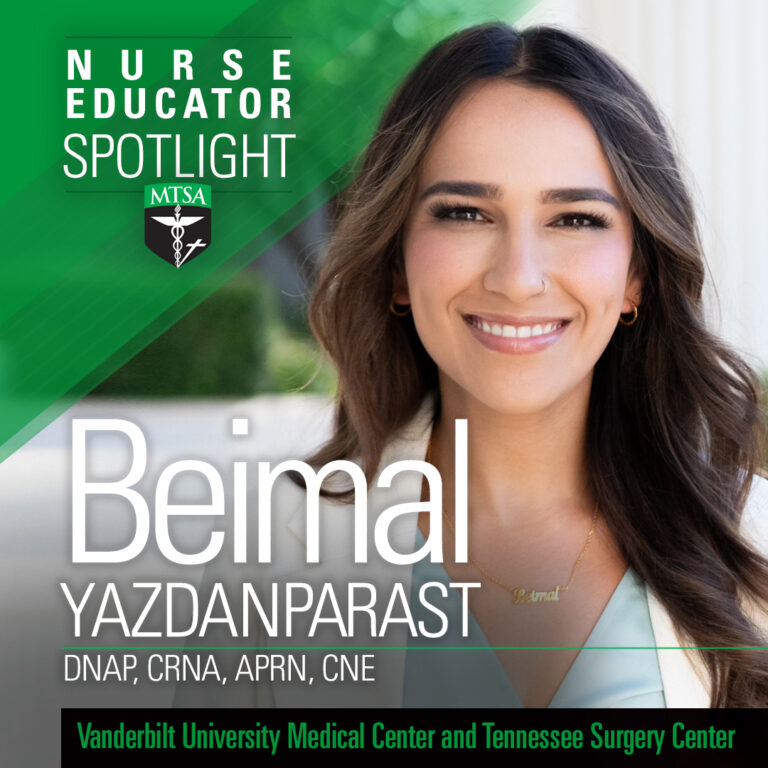
Beimal Yazdabparast is a Certified Registered Nurse Anesthetist and Certified Nurse Educator. She has been a CRNA for six years in various settings and practices including obstetrics, pediatrics, and adult specialty anesthesia at Vanderbilt University Medical Center and Tennessee Surgery Center. Precepting over the years influenced her to complete her doctorate to teach future CRNAs.
In conjunction with the Doctorate Completion Program, she also completed the Nurse Educator Track. While in the program, she became an adjunct faculty member teaching OB Anesthesia at MTSA. She has had the opportunity to organize lectures, present live lectures, and administer exams. Her hard work, determination, collaboration, and passion allow her to become an educator who supports SRNAs to flourish into successful and skilled CRNAs.